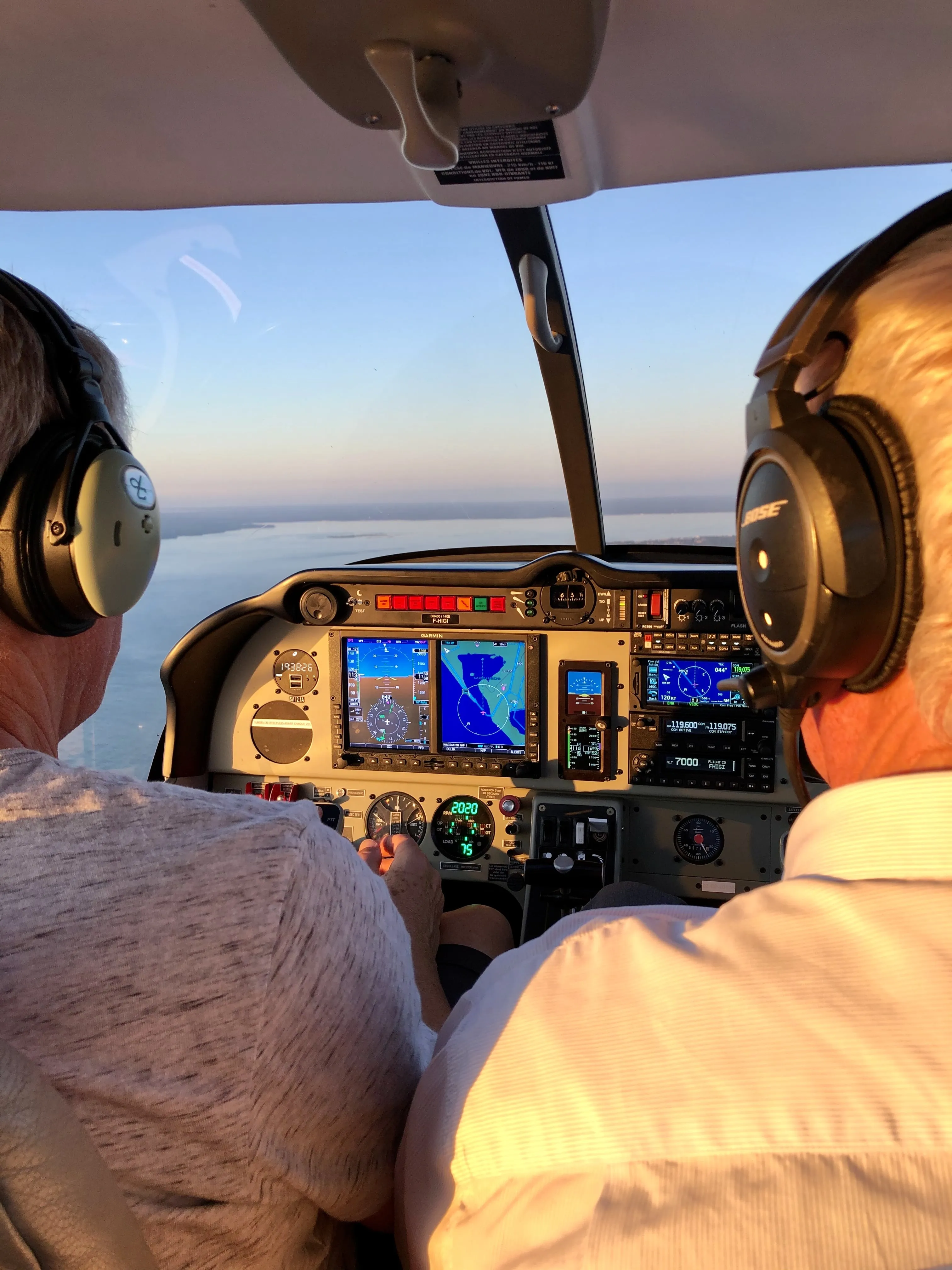
TL;DR
- Under FAA rules, acting as PIC and logging PIC are different questions. §61.51 provides several ways to log PIC, including sole manipulator, sole occupant, acting PIC when more than one pilot is required, and serving as an authorized instructor.
- Under EASA rules, PIC logging follows the pilot’s function and the cases listed in AMC1 FCL.050. These include solo, SPIC, PICUS, instruction, examining, successful checks, and certain supervised operations.
- Two pilots may sometimes log PIC for the same FAA flight, but each needs a valid and separate §61.51 basis.
- A person relying only on a student pilot certificate generally logs PIC during qualifying solo flight, not dual instruction.
- PICUS, SPIC, supervised time, and successful EASA checks need the required countersignature.
Acting as PIC and logging PIC are different
Acting as pilot in command means holding final authority and responsibility for the operation and safety of the flight. Logging PIC means recording time under a rule that allows you to place it in the PIC column.
Those two ideas often overlap, but not always. A rated pilot receiving instruction may log FAA PIC as sole manipulator while the instructor also logs PIC for serving as the authorized instructor. On a single-pilot flight with two rated pilots aboard, the pilot who agreed to act as PIC may be legally responsible for the flight yet have no PIC time to log while the other pilot manipulates the controls.
Start with the rule that applies to the logbook entry. Do not assume that the person flying, the person responsible, and the person entitled to log PIC must always be the same.
FAA PIC logging under §61.51(e)
14 CFR §61.51(e) contains several distinct PIC logging provisions.
Sole manipulator of the controls
A sport, recreational, private, commercial, or airline transport pilot may log PIC while acting as the sole manipulator of the controls of an aircraft for which the pilot is rated. Sport-pilot privileges have their own category-and-class language.
For this provision, “rated” means the pilot holds the required category and class rating and, when applicable, the type rating. Acting as the flight’s designated PIC is not an additional requirement for sole-manipulator logging.
Sole occupant
A sport, recreational, private, commercial, or airline transport pilot may also log PIC when they are the sole occupant of the aircraft. Student pilots have a separate rule, discussed below.
Acting PIC when more than one pilot is required
Except for sport and recreational pilots, a pilot may log PIC while acting as PIC of an aircraft for which more than one pilot is required by its type certificate or by the regulations governing the flight.
This is why a captain can log PIC while the first officer manipulates the controls. The captain’s basis is acting PIC of an operation that requires more than one pilot, not sole manipulation.
Other FAA provisions
Section 61.51 also covers ATPs acting as PIC in operations requiring an ATP certificate, authorized instructors, student pilots, certain supervised PIC training, and an approved second-in-command professional development program under Part 135. Each provision has its own conditions.
When two FAA pilots may log PIC
Two pilots can sometimes log PIC during the same period because they qualify under different provisions.
Consider a rated private pilot receiving instruction in an aircraft for which they hold the category and class rating. The pilot flies the aircraft and logs PIC as sole manipulator under §61.51(e)(1)(i). The CFI logs PIC under §61.51(e)(3) because they served as the authorized instructor and are rated to act as PIC of the aircraft.
That example does not apply to an ab-initio student who holds only a student pilot certificate. During dual instruction, that student logs training received, not PIC. Calling both people “students” in casual conversation hides an important difference: a rated pilot training for an additional certificate or rating may qualify for sole-manipulator PIC, while a student pilot certificate holder does not qualify under that provision.
The safety-pilot case
During simulated instrument flight, §91.109 may require a safety pilot. The pilot under the view-limiting device may log PIC as sole manipulator when rated for the aircraft. A qualified safety pilot may log SIC under §61.51(f) because the regulation requires a second pilot for that operation.
If the pilots agree before the flight that the safety pilot will act as PIC, and that pilot is qualified to do so, the safety pilot may instead log PIC for the period during which the safety pilot acts as PIC. The pilot under the hood may still log PIC as sole manipulator. The two entries rest on different provisions.
FAA rules for students, instructors, and supervised PIC
Student pilots
Under §61.51(e)(4), a student pilot may generally log PIC only when all three conditions are met:
- The student is the sole occupant of the aircraft.
- The student has the solo endorsement required by §61.87.
- The student is training for a pilot certificate or rating.
The rule contains a separate provision for a student pilot performing PIC duties in an airship that requires more than one pilot. For ordinary aeroplane training, a student pilot certificate holder does not log PIC during a dual lesson.
Flight instructors
A certificated flight instructor may log PIC for the time spent serving as the authorized instructor in an operation when the instructor is rated to act as PIC of the aircraft. This does not depend on which seat the instructor occupies.
The trainee’s logging depends on the trainee’s own qualifications. A rated trainee who is sole manipulator may also log PIC. An ab-initio student pilot does not.
Airline transport pilots
An ATP rated to act as PIC of the aircraft may log all flight time while acting as PIC of an operation that requires an ATP certificate.
PIC duties under supervision
Section 61.51(e)(1)(iv) permits a commercial or airline transport pilot to log PIC while performing PIC duties under a qualified supervising PIC. The rule requires an approved PIC training program, the appropriate aircraft ratings, a qualified supervisor, and a signed logbook certification from the supervising PIC. It is a specific training provision, not a general way to turn any supervised flight into PIC time.
EASA PIC logging under FCL.050
EASA uses a different structure. FCL.050 requires pilots to keep a reliable record of their flights, while AMC1 FCL.050 explains how flight time should be recorded.
| Scenario | PIC logging under AMC1 FCL.050 | Condition |
|---|---|---|
| Licence holder acting as PIC | Yes | The pilot is the PIC |
| Solo flight | Yes | Log as solo and PIC |
| SPIC | Yes | Instructor countersignature required |
| Flight time under supervision | Yes | Instructor or examiner countersignature required, as applicable |
| Successful skill test, proficiency check, or assessment of competence | Yes | Instructor or examiner countersignature required, as applicable |
| Instructor in an aircraft | Yes | The certificate holder acts as instructor |
| Examiner in an aircraft | Yes | The examiner occupies a pilot seat and acts as examiner |
| PICUS in a required multi-pilot operation | Yes | PIC countersignature required |
| PIC under a supervisor when Regulation (EU) No 965/2012 requires it | Yes, for pilot and supervisor | The Air Ops supervised-PIC provision applies |
Unlike the FAA, EASA does not have a general sole-manipulator rule. Simply being the pilot flying does not turn ordinary co-pilot time into PIC time. The entry must fit one of the AMC1 FCL.050 cases.
Changes introduced in 2025
ED Decision 2025/002/R amended AMC1 FCL.050 in two ways that matter here:
- Successful skill tests, proficiency checks, and assessments of competence may be logged as PIC when countersigned by the instructor or examiner as applicable.
- When Regulation (EU) No 965/2012 requires a pilot to act as PIC under another pilot’s supervision, both the pilot and supervisor may log the flight as PIC.
These are specific provisions. They do not create a general right for two EASA pilots to log PIC whenever one supervises the other.
PICUS and SPIC
PICUS means pilot in command under supervision. A co-pilot may log PICUS as PIC time on an aircraft that requires more than one pilot when the co-pilot performs all PIC duties without intervention by the actual PIC in the interest of safety. The supervision method must be acceptable to the competent authority, and the PIC must countersign the entry.
SPIC means student pilot in command. The student performs PIC duties under instructor supervision. SPIC time is entered as PIC, but the instructor must countersign it.
The countersignature is part of the logging rule in both cases. A flight may still have happened without it, but the unsupported entry does not meet the AMC condition for logging that time as PIC.
EASA’s 30-minute series rule
When a licence holder completes several flights on the same day, returns to the same departure point after each one, and leaves no more than 30 minutes between successive flights, AMC1 FCL.050 allows the series to be recorded as one entry.
The provision is useful for circuits and other repeated local flights. FAA §61.51 has no equivalent express aggregation rule, so do not automatically apply the EASA shortcut to an FAA record.
Common PIC logging mistakes
Treating pilot flying as PIC under EASA
On a normal multi-pilot EASA operation, the designated commander logs PIC and the other pilot logs co-pilot time. Hand-flying the departure or approach does not by itself change the pilot function.
Treating every dual lesson the same under FAA rules
A rated pilot may log sole-manipulator PIC while receiving instruction. A person relying only on a student pilot certificate may not. Check the pilot’s existing ratings before deciding what belongs in the PIC column.
Logging sole-manipulator PIC without the aircraft rating
FAA §61.51(e)(1)(i) requires the pilot to be rated for the aircraft. A missing category, class, or required type rating defeats that logging basis.
Using unsigned PICUS or SPIC time
AMC1 FCL.050 requires the relevant PIC or instructor to countersign PICUS and SPIC entries. A pilot cannot repair the legal basis by merely writing “PICUS” or “SPIC” in the remarks column.
Calling every incorrect entry falsification
An incorrect entry should be fixed, but a mistake is not automatically intentional falsification. Do not leave a known error in place, and never make a knowingly false entry.
What the logbook entry needs
For time recorded under FAA §61.51(a), each logged flight or lesson needs the date, total flight or lesson time, departure and arrival locations, aircraft type and identification, the type of pilot experience or training, and the applicable flight conditions. A required safety pilot’s name also belongs in the entry.
AMC1 FCL.050 asks for more detail. It includes the PIC’s name; date; departure and arrival places and times; aircraft type, make, model, variant, and registration; SE or ME indication when applicable; total time; accumulated time; pilot function; and operational conditions. PICUS, SPIC, supervised time, and successful checks need the applicable countersignature.
Skyden records PIC, SIC, dual, and instructor time, with separate fields for PICUS, examiner, and safety-pilot status. When the pilot selects their crew function, the flight form fills the corresponding role time from the flight duration. Multi-pilot flights can also alternate pilot-flying and pilot-monitoring status and assign takeoffs and landings accordingly. Its digital-signature flow stores the signer and signature with the flight. The pilot remains responsible for choosing the correct legal basis and obtaining any required countersignature.
Frequently asked questions
Can two pilots log PIC on the same FAA flight?
Yes, when each pilot qualifies under a different §61.51 provision. A rated pilot may log sole-manipulator PIC while an authorized instructor logs PIC for instructing. A pilot under a view-limiting device and a safety pilot who is acting PIC may also both log PIC for the applicable period. Each entry needs its own legal basis.
Can I log FAA PIC in an aircraft I’m not rated for?
Not under the sole-manipulator provision. Section 61.51(e)(1)(i) requires the appropriate category and class rating and, when required, a type rating. Other PIC logging provisions have their own requirements.
Can a student pilot log PIC during a dual lesson?
A person relying only on a student pilot certificate cannot log PIC for an ordinary dual lesson. Under §61.51(e)(4), student-pilot PIC time generally requires the student to be the sole occupant, hold the required solo endorsement, and be training for a certificate or rating. A rated pilot receiving additional training is different and may qualify under the sole-manipulator provision.
Does EASA PICUS count toward ATPL experience?
It can, but the applicable licence requirement determines how much credit applies. For an aeroplane ATPL, FCL.510.A requires 250 hours as PIC or at least 70 hours as PIC with the remainder as PICUS. Do not assume every PICUS hour satisfies every PIC minimum in Part-FCL.
Can an EASA pilot log a successful check as PIC?
Yes. Under AMC1 FCL.050 as amended by ED Decision 2025/002/R, a successful skill test, proficiency check, or assessment of competence may be logged as PIC when the instructor or examiner countersigns it as applicable.
Is acting as PIC the same as logging PIC?
No. Acting as PIC concerns operational authority and responsibility. Logging PIC depends on the specific FAA or EASA provision that applies. The two can overlap, but one does not automatically prove the other.
Sources
- 14 CFR §61.51: Pilot logbooks
- 14 CFR §91.109: Flight instruction and simulated instrument flight
- EASA Easy Access Rules for Aircrew
- EASA ED Decision 2025/002/R
For the required fields behind these PIC entries, read 14 CFR 61.51 Explained: FAA Pilot Logbook Requirements and EASA Pilot Logbook Requirements: The Complete Guide. Pilots working across both systems can also use the EASA vs FAA logbook comparison.
 Start 7-Day Free Trial